Recap: Dinner at Tokyo's Sushi Akira (すし良月)
In preparation for our inaugural tour, A Taste of Tokyo: The Finer Things happening June 15-22, 2026, Nickie and I dined at six of Tokyo’s (+1 of Fukuoka’s!) sushi-ya last winter. We were on an endless and impossible search for the best sushi in the world. Part two is below.
Sushi Akira - The Basics
Dining Date
Jan. 8, 2026 17:30, Dinner Seating
How to Book
Very difficult on omakase.in. Reservations are released as midnight JST on the first of every month for the following month; however, many or all slots may already be taken by regulars by that time. Infrequently, you may see a cancellation slot open up as we did for this meal.
Cost
Omakase course only, not including add-ons or drinks: JPY44,000
Photos
For a full photolog of this meal, check out the Instagram stories for @Explore.Soigne starting here and continued here.
Background
Sushi Akira opened in November of 2019 under taisho (chef) Kazunori Maeiwa when he was only 28 years old. Maeiwa san spent the preceding seven years at nearby Sushisho Masa before branching out on his own. Always humble, the name Akira is a nod to his grandfather’s name instead of his own.
Two years after opening, he had already achieved a Hyakumeiten (Tabelog Top100 in Category award) which is no easy feat in the Tabelog Sushi category. From there, his scores and accolades have skyrocketed (currently sitting at a 4.51 rating), and he has achieved Tabelog Silver every year since 2024. This makes Sushi Akira the #14 ranked sushi-ya out of about ~32,000 in Japan.
Sushi Akira is located at the border of Ebisu and Shirokane off a busy street (the same street as Mizuki, actually) and, like Mizuki, it’s adorned with just a small sign and a single solid wood door. Stepping in, you notice immediately that this is going to be an intimate affair. There are eight seats total (four on each side) at an L-shaped, single-level counter and everyone is tightly packed. One peculiarity you notice is that there are two large heat lamps on the far right side of the counter (we’ll get to that later!). We were lucky enough to be seated directly in front of Maeiwa san.
As the restaurant itself is just off the busy road, you do hear some street noise bleeding into the restaurant. This becomes less relevant as the energy picks up throughout the meal and everyone gets chatty, familiar and a little drunk. This is not your typical, subdued sushi counter.
The drinks list is excellent, featuring rare sake producers (Aramasa, Nichi Nichi and some boutique producers from chef’s home prefecture of Wakayama all make appearances) as well as a fantastic wine list. We started with a bottle of 2012 Champagne Larmandier-Bernier Vieille Vigne du Levant before switching to nihonshu (sake).
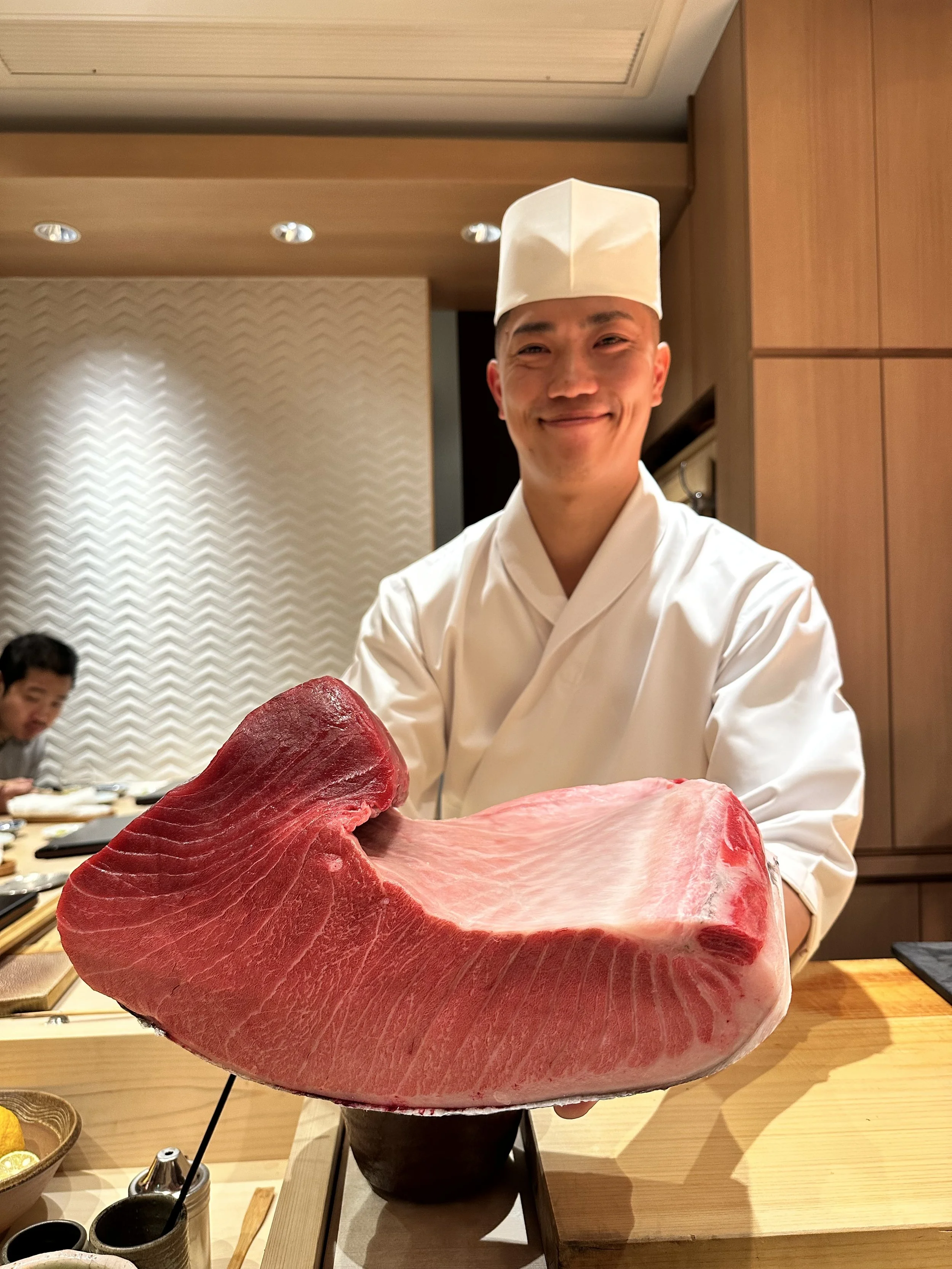
Before any food is served, the staff parade around some of the fish we will be sampling today. Usubahagi (Unicorn Leatherjacket) and Aji (Horse Mackerel) are presented whole and we are told that one of the chefs drove to Kanagawa (two hours away) this morning (!) to pick them up directly from the fisherman who caught it. Next on display is a giant cut of Maguro (Bluefin Tuna) from a 110kg behemoth caught this morning in Miyagi. We’re teased that this is only one of three separate Maguro that will be served today. A 10kg Meji Maguro (Baby Bluefin) and a 40kg medium size from Kanazawa will also make appearances.
We soon learn that this dedication to sourcing direct from fishermen is the basis for our entire meal. Maeiwa san explains to us that in tonight's omakase not a single item was sourced from a fish market. Not only that, but outside of the Uni (Sea Urchin), everything was caught this morning. This is virtually unheard of in Tokyo, where chefs are usually bragging about who their famous wholesaler is at the Toyosu fish market instead.
Tsumami (appetizers)
Now that we’re salivating from the seafood runway show, it’s time to eat! We are served seven tsumami before the nigiri.
Awabi (Abalone) is sourced directly from ocean divers in Niigata prefecture and served steamed (four five hours) with a dipping sauce of its own liver mixed with shiro miso (white miso). A nice, very saline bite that mixes wonderfully with the miso and clean liver flavor. This really woke my palate up with the fresh flavor of the sea, much like an oyster at the beginning of a meal.
Two slices of Akami Zuke (Soy Marinated Lean Bluefin Tuna) sashimi are served next from the medium size 40kg Maguro (Bluefin Tuna). These slices were a little firmer with a nice meaty texture that paired nicely with the Fukui Jigarashi mustard served on the side. This is a whole-grain mustard that is less horseradish spicy and more of a complex fruity flavor. Great pairing that reminded me a bit of how you serve mustard with Tonkatsu (fried pork cutlet).
Next, we’re shown a large piece of Meji Maguro (Baby Bluefin) with its skin on and skewered ready for binchotan grilling. Maguro skin is typically inedible, even when cooked, due to its tough and thick nature. However, when they are babies the skin is thin enough for grilling. Maeiwa san, with one hand on a wooden fan and the other with the skewers looks like a yakitori master as he just barely sears the skin over the binchotan charcoal until perfectly crispy. He then slices up two sashimi per person. The skin is shatteringly crisp and the baby fat from the tuna is so sweet, cold and melting. Perfect bite.
Usubahagi (Unicorn Leatherjacket) is a shiromi (white-fleshed fish) that is new to me. It is served in a similar fashion to Kawahagi (Japanese Filefish) with its own liver which makes sense as they belong to the same family. Here, a sashimi slice of the fish is wrapped around its own liver and served with a small piece of sudachi citrus. A nice textural bite of the fish leads way to the cleanest, zero mineral flavor liver and the sudachi giving it all a nice tang. Like sour cream from the ocean.
The flavor is amped up a notch now with a Saba (Mackerel) hand roll. A circular slice of half shari (sushi rice) and half thick-cut saba is wrapped in a sugar and soy marinated Wakayama wakame (seaweed) then placed in a taco shell of nori (dried seaweed) served with a little wasabi and sansho pepper. The sweetness of the wakame plays so well with Maeiwa san’s shari and Saba with a little kick of heat from the wasabi and sansho. I could have eaten quite a few more of these.
The skewers are out again for the rare Nodoguro (Blackthroat Seaperch) sometimes called the Toro (Fatty Tuna) of shiromi (white fleshed fish) because of its high fat content, especially in winter. Marinated very simply in only specialty Mitsuboshi soy sauce and served with grated radish on the side I’m not sure that a piece of grilled fish gets better than this. Oily, unctuous and surprisingly sweet, this was grilled to perfection with a beautiful char on the skin while leaving the opposite side almost uncooked.
Finally, to transition from tsumamito nigiri, we are served a beautiful black lacquerware bowl which we open to a cloudy liquid of Hamaguri (Hard Clam) Dashi. Only Hamaguri, Kombu seaweed and water are used here (no salt!) but it is salty and piping hot. Cleansing and soothing.
Nigiri
Tai (Sea Bream) - Taisho uses two different vinegars for his shari (sushi rice) depending on the fish. With shiromi (white fleshed fish), like the one here he uses his more delicate white vinegared rice. This plays really well with the super fresh and light umami from the Tai. The neta (fish topping) is cut quite generously.
Shiro Amadai (White Horsehead) was thickly cut (very generous for such a rare fish) and had a deep umami, but with a fresh salinity I hadn’t experienced before in this fish. Throughout the meal Maiewa san emphasized that these morning caught fish have firmer texture and cleaner flavor than what you normally get from markets. It was definitely evident here.
Chutoro (Medium Fatty Bluefin Tuna) is a fairly typical cut, but here we are served the chiai gishi from right along the bloodline. This piece acts as a bridge between the lean akami and the fatty toro belly. The piece is reminiscent of a sunset going with a visible distinction of dark red to light pink from top to bottom as the fat content increases. Absolutely fantastic aroma and flavor balanced with a variety of texture and expertly paired with our first taste of Maeiwa san’s sharper red vinegar shari.
Otoro (Fatty Bluefin Tuna) is next up. No searing gimmicks, no nonsense. Just a generous piece of perfectly marbled tuna belly paired again with strong red vinegared shari. Luxurious aroma and flavor that could rival any Toyosu top wholesaler’s Maguro.
To complete our out of order Maguro trio we end with Akami (Lean Bluefin Tuna) “a little Zuke” (soy marinated). Lovely cut full of intense tuna umami. This is quickly becoming my favorite cut of tuna. The lack of fat really lets the tuna flavor shine through, the same way a skirt steak might show its meatiness versus a ribeye.
Kohada (Gizzard Shad) is up next. Cured for two days, this is a gorgeous, shining piece of Hikarimono (Silver Skinned Fish). I typically like a little more vinegar and fishiness in my Kohada, but Maeiwa san’s style is super clean. More focused on texture and the flavor of the ocean itself versus covering it with vinegar and sugar. I respect it even though it’s not my preference.
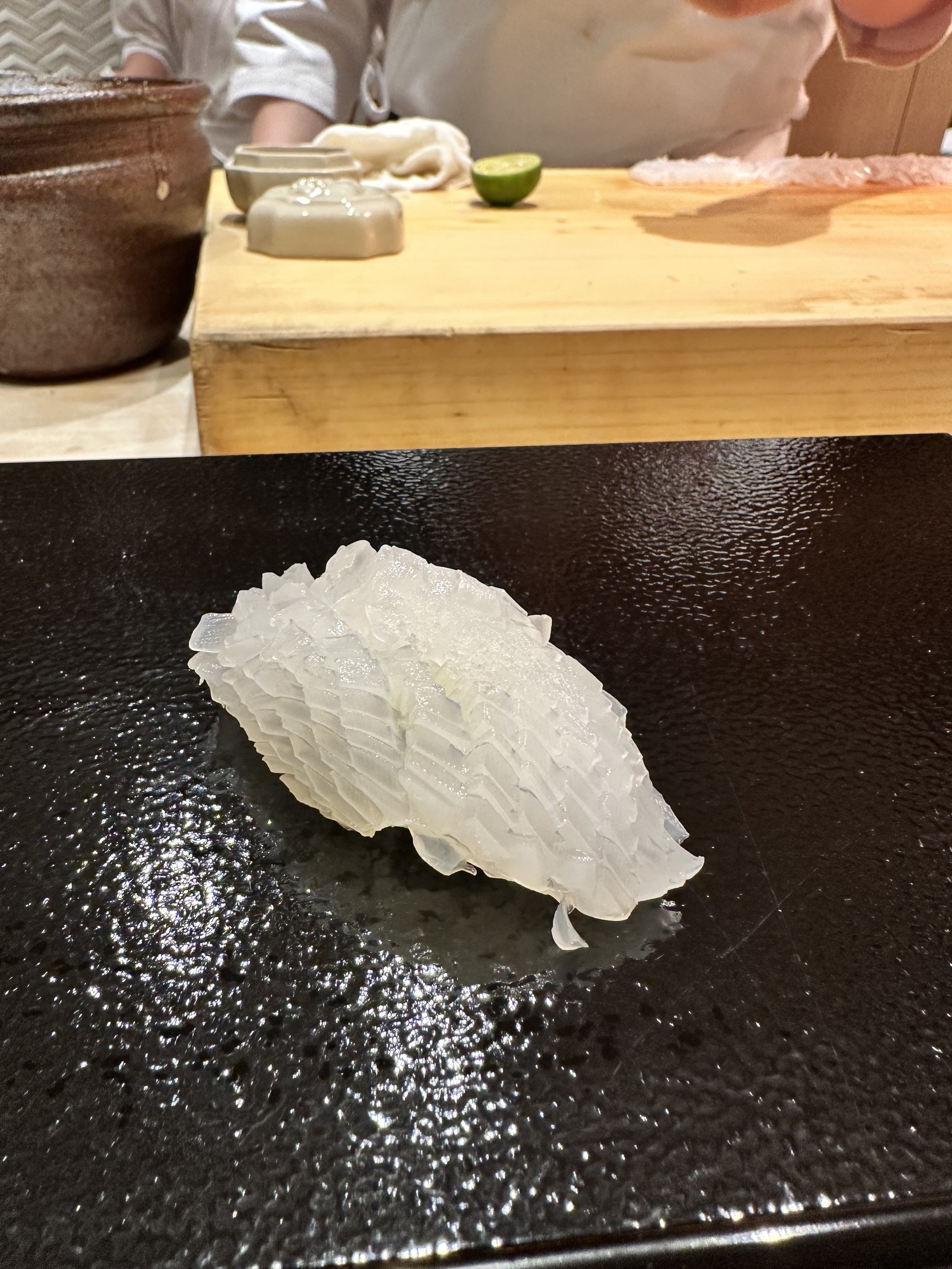
A whole Aori Ika (Bigfin Reef Squid) was caught this morning and killed in the Ikejime method (brain spiking, causing instant death with no tensing of the muscles). This was shown to us completely whole and so fresh the nerve endings still reacted when one of the chefs ran a finger across the skin. These squid have many, many layers of skin and are painstaking to clean and prepare for sushi, which is why the prep work is usually done behind the scenes long before any guest arrives. Not here. One chef was tasked with removing all the skin and doing the intricate knife work of prepping this squid for nigiri in front of us for over 45 minutes. For the final cuts, Maeiwa san took over and scored hundreds of marks across the cleaned squid until it was paper thin and covered the shari like a thin, spiky porcupine shell. The result was a glorious texture that just melted like a cloud of sweet ocean water. I believe this is one of Maeiwa san’s signature pieces and it’s easy to see why. Stunning.
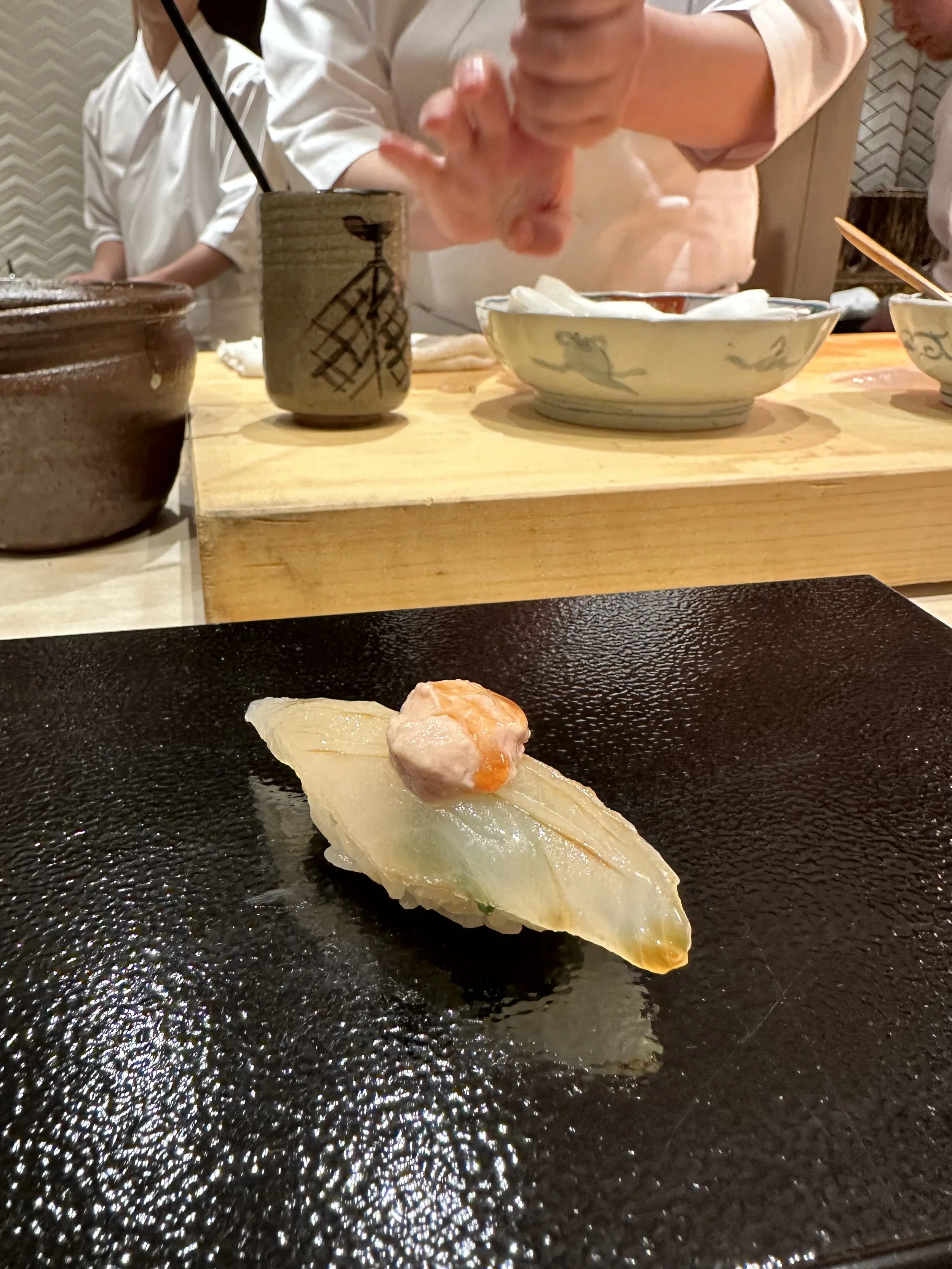
Up next a long cut of Kawahagi (Japanese Filefish) is draped over a chive-covered shari with a big dollop of its own liver on top of the neta. The flavor of Kawahagi liver easily rivals or even sometimes beats Foie Gras or Ankimo. It feels almost as rich as Foie, but with a clean, saline note that is not fishy at all. With the mildly umami white fish and the bite of the chive, this piece was wonderful. I’m glad to have had so much Kawahagi on this trip.
Maeiwa san’s eyes lit up when I asked what fish he had just brought out next. The supremely common hikarimono (silver skinned fish) served at sushi-ya around the world Aji (Horse Mackerel) is out now. The flesh on this Aji is so clear I wasn’t sure what fish it was. Taisho explains that most Aji you eat is one or two days old from fish markets and gets a cloudiness that turns it milky white. Here, we’re being served one caught this morning and the flesh is almost clear. None of the jukusei (fish dry aging) flavor here. Just a clean bite with a texture closer to the lean Akami tuna. I might have preferred a little aging to bring out more flavor here.
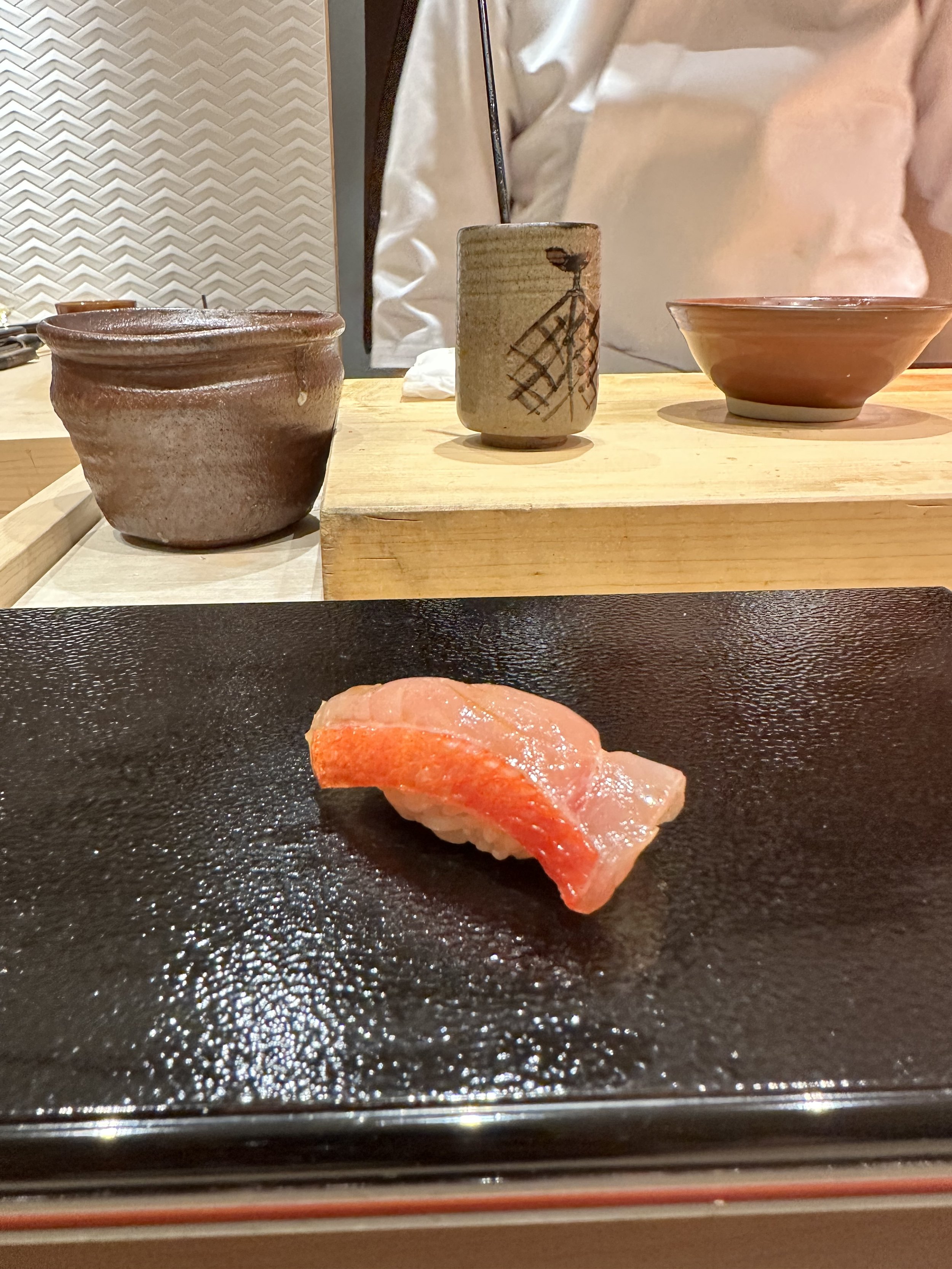
As I mentioned at the beginning of this review, there are two heat lamps here which are very uncommon at a sushi-ya. Early on in the course, Maeiwa san cut some neta of Kinmedai (Golden Eye Snapper) with the beautiful bright orange skin intact on each piece and then left them under the heat lamps for almost an hour. Now, he makes them Zuke style (a quick marinate in soy sauce) and arranges them into nigiri. The fish is warm, he is going for body temperature here. It works super well. Typically you sear the Kinmedai’s skin to get flavor out of a very delicate fish, but with his heat lamp and Zuke technique Maeiwa san manages to melt every ounce of fat and bring out a rich umami flavor without resorting to the gimmicky blow torch. A contender for piece of the night for me.
A giant golden yellow crab shell is placed in front of us on the counter. We are going off the nigiri for a special serving of Ibaragani Modoki (Golden King Crab) next. A beautiful green and brown lidded lacquerware dish is put in front of us and upon opening you are greeted with the aroma of steamed crab meat, shari and shiso leaf. Very sweet and saline with a good kick of vinegar from the rice.
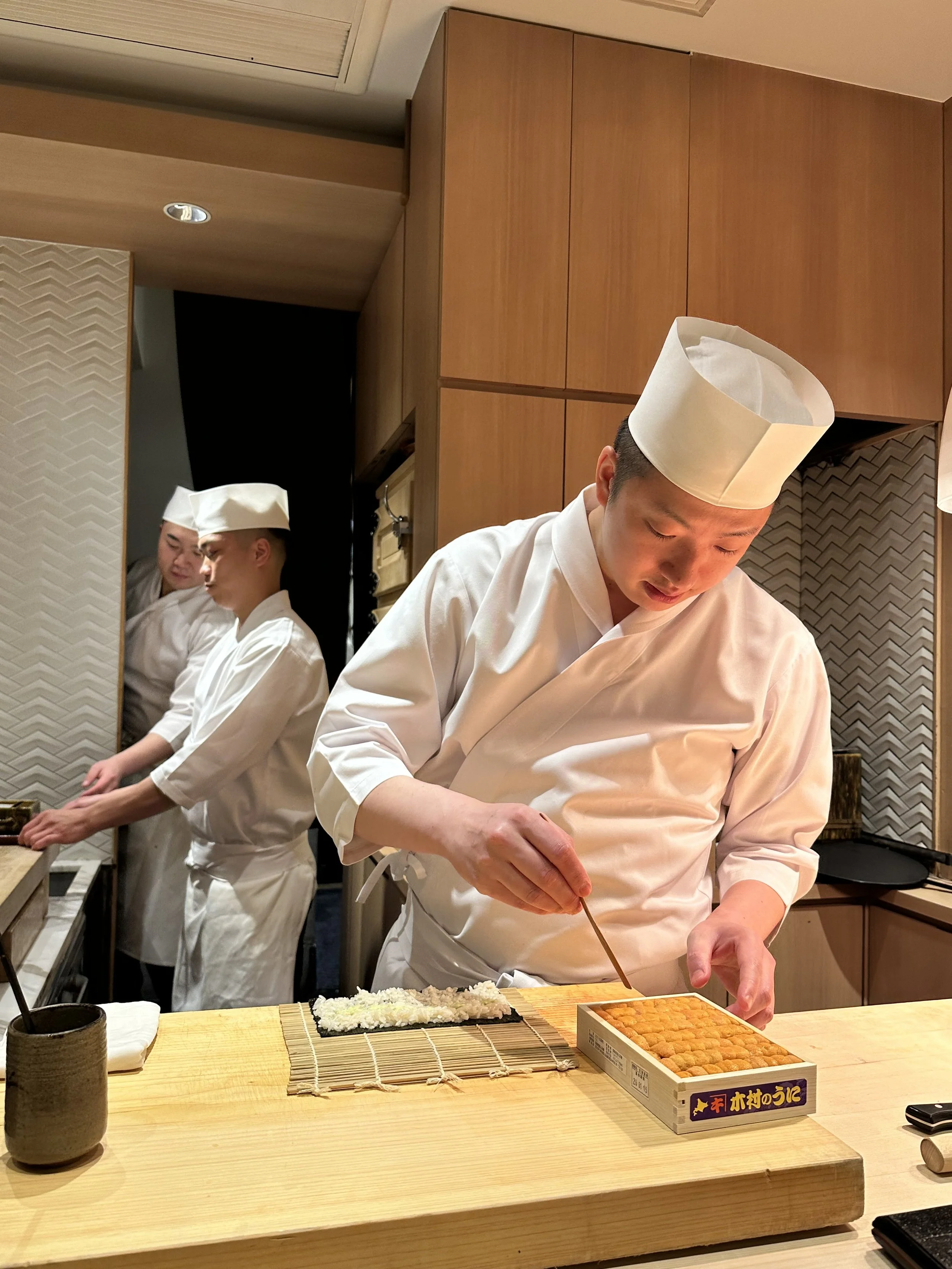
A gorgeous box of Bafun Uni (Hokkaido Uni) is out next which Maeiwa san makes a generous maki (classic seaweed and rice roll) of. Usually cut into bite-sized pieces, here we are generously given a three inch long roll each. Ice cream cone of the sea. Perfectly sweet and mineral. I could eat these forever.
Usually the last two bites of a sushi meal are Anago (Sea Eel) and Tamago (Egg). Here, Maeiwa san creatively combines both into something like a stuffed omelette roll. A thin omellete is rolled around a combination of shari and steamed Anago to create a perfect sweet and savory bite.
Typically after the main course is finished you are offered okonomi (a la carte pieces) of repeats you liked earlier in the course (at an extra cost of course). Here, though, a giant Maguro Kama (Bluefin Tuna Collar) is paraded around behind the counter along with a Sumi Ika (Ink Squid) with its nerve endings still tingling along with some Amaebi (Sweet Shrimp) and a special cold smoked cut of the Meji Maguro (Baby Bluefin) from earlier. Between Nickie and I we ordered all four pieces (and a pour of the exquisite Aramasa Cosmos Sake).
Sumi Ika (Ink Squid) was scored in a less intricate pattern than the earlier Aori Ika and had the typical creaminess you might expect from this piece. Served simply with sudachi citrus and salt this was nice, but not on the level of the earlier piece.
The Amaebi (Sweet Shrimp) was large, much bigger than the shari it sat on and had an intense sweetness almost like the red Palamos Prawns of Spain. This was delicious.
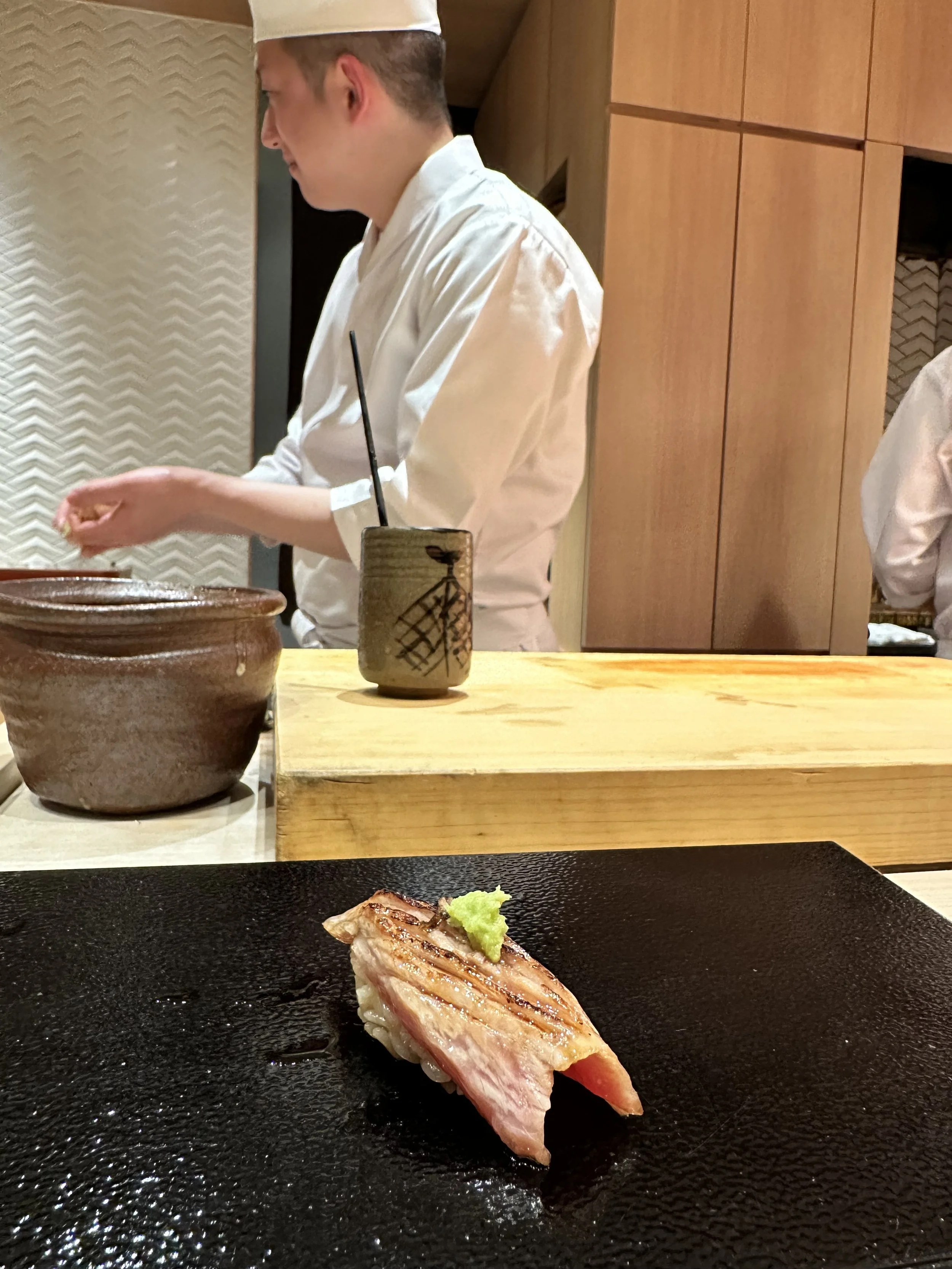
For the Maguro Kama (Bluefin Tuna Collar), Maeiwa san arranged all the prepared nigiri on a plate, then went to his binchotan charcoal grill, placed all the burning hot charcoal into a metal grate basket and slowly tapped the basket on top of the nigiri creating an intoxicating aroma of melted maguro fat and flesh, finished with some grated wasabi. I didn’t get a taste but Nickie assured me it tasted just as good as it smelled. What a sight to behold.
My slightly cold smoked Meji Maguro Otoro (Fatty Baby Bluefin Tuna Belly) is draped over a small piece of shari. This is one of the prettiest pieces I’ve seen, with a repeating ridged pattern to the flesh I am still unsure of how it was formed. I am not exaggerating when I say this was the best piece of otoro of my life. The fat on the baby tuna is somehow so much sweeter than on the larger fish and the texture is less oily without losing the butteriness. The slight smoke amplifies everything. Ending the meal with my bite of the night is very rare and lucky. Wow.
Is Sushi Akira on the shortlist for Tabelog Gold?
This was unanimously the top sushi meal of our winter trip to Tokyo (more to come on a Fukuoka gem we both love) that included some very heavy hitters. The variety of fish and the refusal to go through markets was remarkable and very rare, differentiating himself from almost all of his peers. For many of these fish, tasting them morning-caught was like tasting a completely new fish. That excitement and shock of a new flavor of texture was remarkable. I wonder how it fairs in repeat visits. For some of the pieces (especially the hikarimono) I would have preferred a little bit more jukusei (aging), but I am nitpicking here.
The service here is on another level. Throughout the meal, detailed English explanations and pictures of each fish are shown to you and every single staff member is knowledgeable about each fish. You could sense the entire team's passion and dedication for educating guests about their sourcing process and the importance of fresh seafood. Following Maeiwa san’s social media and seeing his staff interactions, you can also tell he cares a lot about developing young talent, even offering them days of their own to take the reins behind the counter with guests at a reduced price. Additionally, just announced in March 2026, a second restaurant under the Akira name is about to open with one of his top apprentices behind the counter full time.
Tabelog Gold is a finicky thing. Knowing the right reviewers, getting them to come to your shop and playing the PR/politics of Tokyo fine dining all, unfortunately, come into play. Food and service wise, I think Maeiwa san has what it takes and his quick upward trajectory is very promising. Regardless of where the guidebook rankings go, this is a must visit sushi-ya operating at the very top of its game.
Eat Well,
Aria
